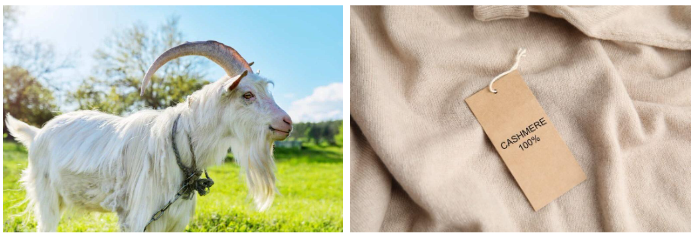
Cashmere, a truly exquisite and rare fiber, is considered one of nature’s finest gifts. The highest quality cashmere is exceptionally rare and renowned for its incredible lightness, softness, and warmth, earning it the distinguished title of “The fiber of Kings”. But what exactly is it, and how does it transform from goat hair to the cozy sweater and scarves we love? Let’s explore the cashmere world and discover its properties, manufacturing process, and origin.
What is Cashmere Fabric:
Cashmere wool is one of the softest types of wool known to man. It is made from the fine hair of cashmere and pashmina goat. The old spelling of cashmere is Kashmir, a region in northern India that still produces this luxurious fiber. Nowadays, the Cashmere region spans across China, Mongolia, Pakistan, Afghanistan, and Iran, where the Capra Hircus is bred at altitudes of at least 4000 meters.
Cashmere wool comes in natural colors like white, brown, and grey. It is often dyed to create trendy shades. Cashmere is a rare and sought-after fiber because of its exceptional qualities. Only a small amount of cashmere is produced, with just 100 grams yielded by one goat and it takes between 4-8 goats to produce enough for one garment. That’s why people often choose cashmere for luxury clothing and it is quite expensive.
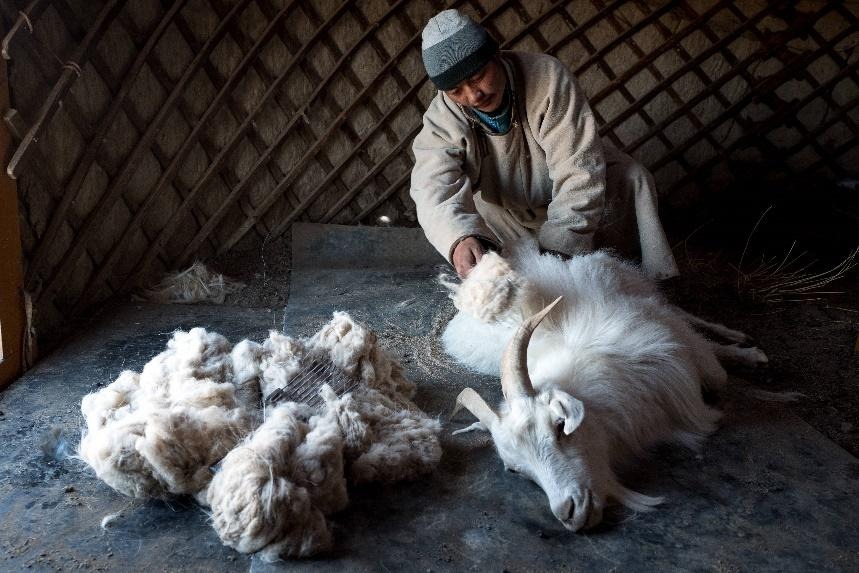
Shearing
Manufacturing process:
Cashmere production and manufacturing are quite complicated. It is very different than traditional, cottage-industry-style production thus making it one of most expensive forms of wool. It can be broken down into several different stages. Such as:
1- Shearing: Initially, the goats are allowed to grow full coats of hair. They are typically shed by the goat during Spring and are collected through hand-combing or shearing. Skilled artisans sort out each fiber based on its colors, origin, and thickness.
2- Cleaning: Once the It has been sorted, it undergoes both the washing and drying process to remove impurities such as grease, dirt, or straw.
3- Combing: After that it passes through a carding machine where it is cleaned, carded, separated, untangled, and aired out to give a fluffy appearance.
4- Spinning: The carded fibers are fed into a spinning machine. By spinning a robust and lustrous yarn is produced.
5- Dyeing: It can be dyed using 3 different methods: fiber dyeing, Yarn dyeing, or Piece dyeing.
6- Warping: Here the cashmere threads are pulled by a drum and then wound around a different drum.
7- Weaving: The finished cashmere yarn is woven into different textile products. By using different thicknesses of yarn and changing the density of the threads, we can create fabrics of different styles and shapes.
8- Final treatments: Wool is naturally flame-resistant. Once the garments are prepared, they may undergo flame-resistant treatments or other forms of treatment.
9- Packaging and shipment: All items are packaged as required and made ready for shipping.
Cashmere vs Wool:
Warmth: Cashmere and Wool differ in warmth. The fibers of cashmere are finer than those of wool, allowing them to trap more heat effectively without adding extra weight or bulk to the garment.
Durability: Wool fibers are naturally elastic, more durable, and perfect for outdoor wear and activewear due to the thicker fibers that make the material more resistant and durable to wear and tear. However, cashmere fibers are quite delicate and tend to pill and wear out quickly compared to wool fibers.
Itchiness: Cashmere is less irritating than wool due to the absence of lanolin, which can cause itchiness. The finer cashmere fibers feel softer and smoother on the skin compared to wool fibers, which can feel rough or scratchy if not properly treated or blended with other fibers.
Care: These garments require more delicate handling and care than wool garments due to their fragility.Cost: It is often seen as a fancy type of natural fiber that is more expensive than wool due to the labor-intensive production process and the fibers are super fine.
Types of Cashmere Fabric:
There are several types of cashmere fabric. Such as:
-Cashmere wool: They are usually made from the cashmere goat of the Gobi Desert and Kashmir regions.
-Pashmina wool: The pashmina goat is closely related to cashmere goat, and their fibers are frequently regarded as the same material.
-Grade C : The cheapest grade of wool that don’t make much contact with the skin.
-Grade B : They are somewhat better than C and mostly mid-grade cashmere.
-Grade A : They are the most expensive higher quality cashmere.
Uses:
Cashmere fabric is commonly used for making suits and coats, but it can also be used in different types of clothing. Such as Dresses, sweaters, scarves, socks, underwear, etc.
They can also be used in home textiles and décor such as quilts, blankets, rugs, and carpets.


In this modern and fast-fashion world, Cashmere stands as an eternal symbol of luxury and refinement. While it may be a bit more expensive and may require special care, its luxurious feeling, incredible warmth, and classic elegance make it a valuable choice that can be cherished for years to come.